By Andrew Bunting, PHS Vice President of Horticulture
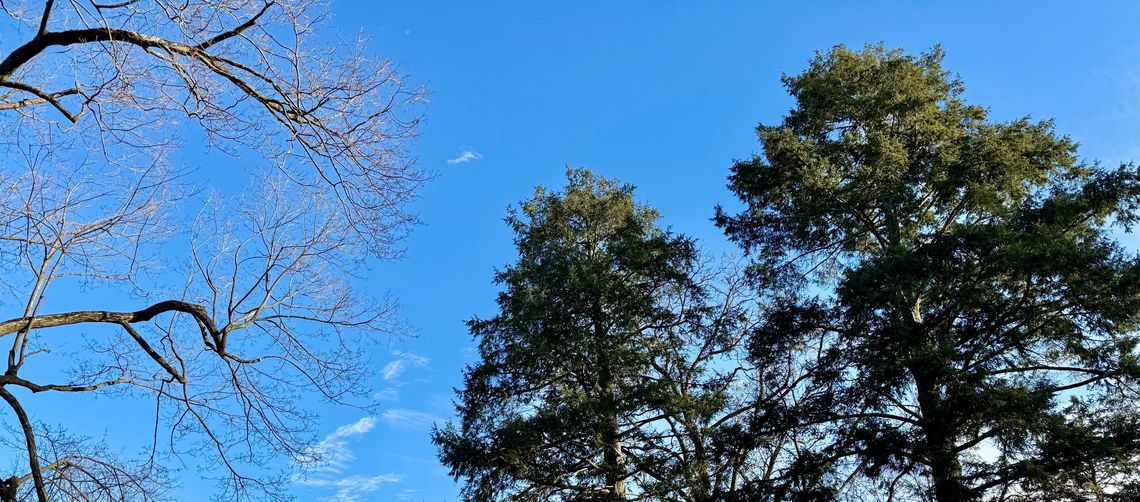
One of the most picturesque and iconic conifers for this region is the Eastern hemlock, Tsuga canadensis (pictured). The evergreen can tower to seventy feet tall at maturity. The small needles are dark green and it has a stately pyramidal habit at maturity. In the wild, it occurs in slopes and ravines throughout a large portion of the Northeast. Unfortunately, over the last twenty years or so hemlocks have been devastated by two invasive pests The Hemlock Woolly Adelgid and the Elongate Hemlock Scale often called Fiorinia Scale. Over time this weakens the trees and they become more and more sparse and eventually die altogether. Horticultural oils and insecticidal soaps are a non-toxic approach to preventing impact from these pests, but this requires a diligent spraying and for large trees an arborist needs to be hired which can come with a considerable expense and the treatment needs to continue regularly. Additionally, the Carolina hemlock, Tsuga caroliniana which is native to the Southern Appalachian Mountains is equally susceptible. Because of these issues hemlocks are rarely planted today as landscape or garden trees.
For many years both the Morris Arboretum and Gardens and the U. S. National Arboretum have promoted the Chinese hemlock, Tsuga chinensis as an alternative to the Eastern hemlock and the Carolina hemlock. It has very similar attributes to both species and has exhibited extreme resistance to the aforementioned insect problems. Unfortunately, the Chinese hemlock has not gotten good traction in the nursery industry and remains relatively obscure today.
Historically, the U. S. National Arboretum has been a leader in tree and shrub hybridizing and breeding. Many excellent selections and cultivars of crepemyrtles, viburnums, flowering cherries, viburnums and many more have been introduced by the National Arboretum. Two selections of hemlocks are recent introductions. Tsuga ‘Traveler’ and ‘Crossroad’ are both interspecific hybrids between Tsuga chinensis and T. carolinana and have shown great resistance to the adelgid and scale. In their youth both cultivars are very dense and have a full pyramidal habit. ‘Traveler’ over time has an elegant habit where the tips of the branches are open and somewhat pendant. ‘Crossroad’ is more upright, symmetrical, and pyramidal.
Both selections hold great promise for the landscape. These majestic conifers were once a staple in gardens in the Mid-Atlantic used as both a specimen tree, but also effectively used for hedging and screening. Hemlocks, in general, are also fairly deer resistant!