By Andrew Bunting, PHS Vice President of Horticulture
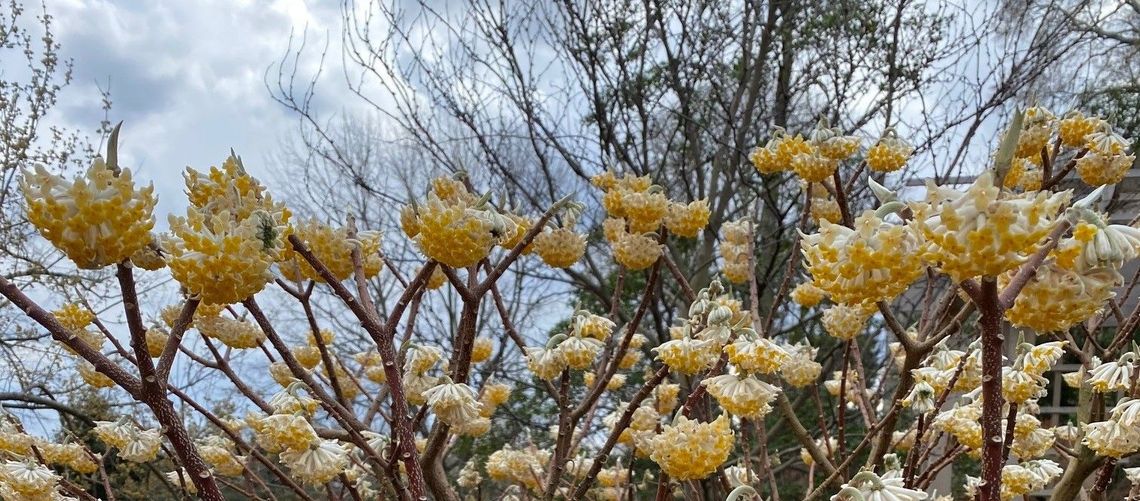
Every year, as we transition from winter into spring, there are a number of trees and shrubs that “take a chance” on spring really being here and start their flowering. Both the star magnolia, Magnolia stellata, and the Yulan magnolia, Magnolia denudata, unveil extraordinary white flowers. The Okame cherry, Prunus × incam ‘Okame’, reveals its bubblegum-pink flowers, and often even earlier, the paperbush, Edgeworthia chrysantha, bursts open with large clusters of fragrant, tubular, golden-yellow flowers.
This shrub, which reaches eight feet tall with a spread of nearly twelve feet, was once considered marginally hardy in the Mid-Atlantic. Today, it is hardy to USDA Zones 6b to 7a. This Asian native is grown for its bold, strap-like leaves, which give it a somewhat tropical effect during the growing season. In late summer, clusters of silvery buds are formed. These clusters hang on the ends of the naked stems and create interesting decoration in the winter garden. Then, in late winter to early spring, depending on the part of the country and how mild the late winter might be, the buds unfurl. Each flower cluster can have nearly 70 tubular flowers. While many are a bright yellow, others can be a softer yellow.
Edgeworthia chrysantha looks best with an evergreen backdrop, such as the Japanese red cedar, Cryptomeria japonica ‘Yoshino’, or Thuja ‘Green Giant’, or a lower broadleaved evergreen such as the inkberry holly, Ilex glabra, or PHS Gold Medal recipient Daphniphyllum macropodum. It grows and matures relatively quickly. The first couple of years in the garden, it will probably have minimal flowers, but once it matures, it will be one of the most stunning plants in the garden.
It grows best in full sun with well-drained soil rich in organic matter. While it is a relative of the daphnes, it is much more stalwart and vigorous and does not suddenly die, as many species of Daphne tend to do. On occasion, there might be a need for selective pruning for it to have its best shape, but this will be minimal.
There is a related species with orange-red flowers, Edgeworthia papyrifera ‘Red Dragon’ (syn. ‘Akebono’), but this selection lacks the vigor of Edgeworthia chrysantha. There are a few cultivars of E. chrysantha, but I have found the straight species to be as good as any of the cultivars.
In addition to having incredible ornamental value in the garden in late winter, it can also be used for cut branches, which will perfume the entire house.