leaf icon
leaf icon
leaf icon
calendar icon
Gardens To Visit
caret icon
Visit a PHS garden or landscape to help build stronger social connections with your community.
For Neighborhoods
caret icon
Explore programs that create healthy, livable environments and increase access to fresh food.
For Gardeners
caret icon
About Us
caret icon
Get to know our story, become a part of our staff, or see what is in the news with PHS.
The Flower Show

Ecological Hedges

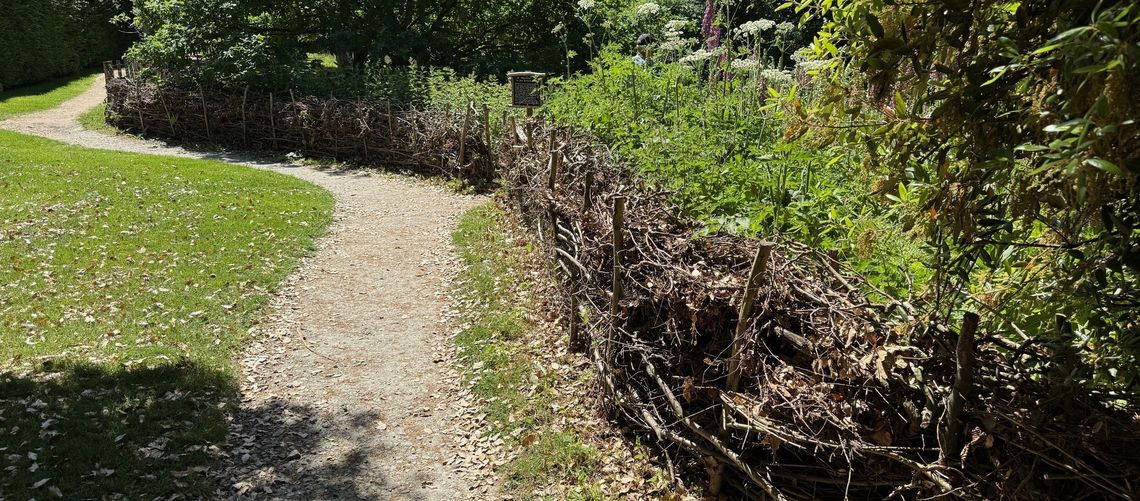
dead hedge at hidcote garden

By Andrew Bunting, PHS Vice President of Horticulture


There are several approaches to create visual hedges or barriers in the garden that can also serve a myriad of ecological functions.  Traditional hedges like the invasive privet, Ligustrum ovalifolium can be replaced with more interesting and ornamental native options and at Stoneleigh Gardens they have created a mixed hedge of native plants to create a very biodiverse hedge.  There is also an approach called “dead hedging” where material gathered from the garden like cut stems and twigs and branches are aesthetically stacked to create interesting architectural forms which will the support wildlife in the garden. 

There is often a need to create a living barrier or a hedge between properties to create privacy.  Historically, this has been done with the very common privet.  Today, privet is considered one of the most aggressive and insidious of the many invasive plants which are invading our local native areas.  If a privet hedge is sheared at least once a year then it does not really pose a problem, but what inevitably happens is that it gets forgotten and does not get pruned and then the privet plants start flowering and then fruiting.  The fruits are eaten by birds and disseminated into local native areas where privet plants establish themselves and choke out the native flora.

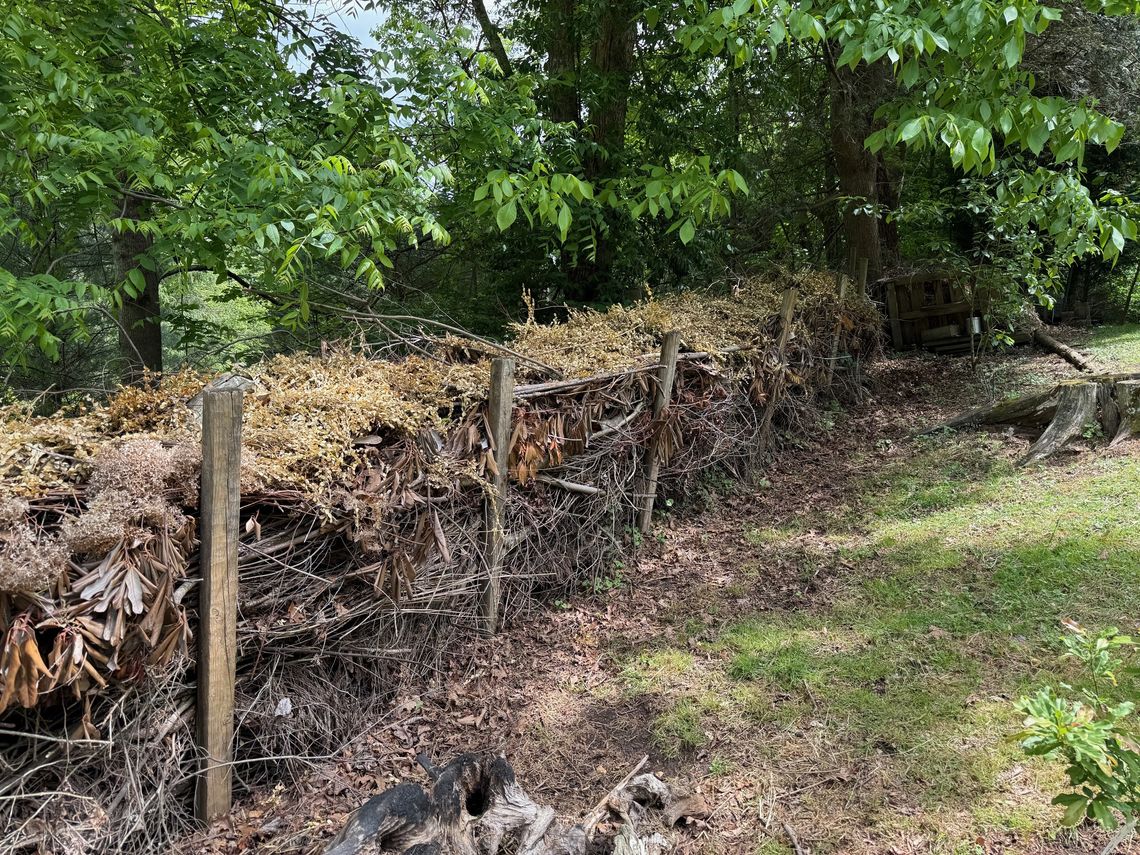
dead hedge at andra nus garden
Dead Hedge at Andra Nus' garden

For evergreen hedges there are many native options including the inkberry, Ilex glabra, which is a shrub with narrow, glossy leaves and black “ink” colored small fruits.  The straight species can reach ten feet tall, but there are many more diminutive cultivars like ‘Densa’ and ‘Shamrock’.  American holly, Ilex opaca is another good choice for evergreen screening.  It has broad spiny leaves.  There are literally hundreds of cultivars.  The Scott Arboretum and Gardens at Swarthmore College has a national collection of hollies which can be used to select the best holly for your home garden.  Some notable cultivars include ‘Satyr Hill’ and ‘Jersey Princess’.  The American Holly can get fairly tall over time therefore some selective pruning might be considered to maintain a desired size and form.  Other native evergreen plants for naturalistic hedges include the Florida anise, Illicium floridanum; Devilwood, Osmanthus americanus (syn. Cartrema americana) and Carolina cherry laurel, Prunus caroliniana. 

The aforementioned mixed hedge which is on display at the nearby Stoneleigh Gardens is an interesting approach to hedging.  They have created a very long privacy hedge using both evergreen and deciduous shrubs and trees.  The hedge is selectively pruned on occasion to maintain a hedge-like appearance.  With dozens of mixed species the hedge provides great protection and habitat for native birds and insects, as well as, food sources because of the diversity of the plants.  A simple mix that could be considered for a home garden might include the American holly, Ilex opaca; arrowood, Viburnum dentatum;chokeberry, Aronia arbutifolia; summersweet, Clethra alnifolia;  spicebush, Lindera benzoin; Virginia rose, Rosa virginiana; Washington hawthorn,  Crataegus phaenopyrum; sweetbay magnolia, Magnolia virginiana var. australis and common witchhazel, Hamamelis virginiana.  The species could be planted alternately throughout the hedge or randomly for a more naturalistic approach. 
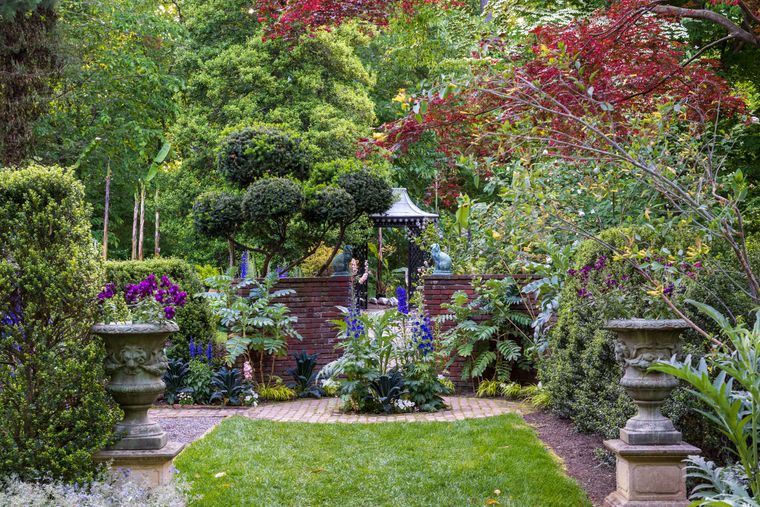
dead hedge at hidcote garden
Dead Hedge at Hidcote Garden

Over the last several months I have seen dead hedges in both public and private gardens in both the United States and Europe.  The approach to a dead hedge can be very straight forward.  Every five to ten feet two posts about four to six feet apart are pounded into the ground.  These posts begin the framework for adding stacked material.  I have seen dead hedges with large branches, logs, twigs, cut perennials from the garden, etc.  The hedges can be straight or curved.  They can be the same level or undulating to create a more aesthetic feature in the garden.  Material that would otherwise be put out with the trash to be gathered by the municipality stays on your property to decay and ultimately become part of the soil.  The stacked branches and other organic material are constantly decomposing with becomes a great habitat for many ground dwelling insects.  The dead hedge can also be a food source for native birds and a potential nesting site for native birds, mammals, insects, amphibians and reptiles. 

Both the living native hedges and the “dead hedge” are two approaches to creating a naturalistic barrier in the garden while providing immense ecological benefits.