leaf icon
leaf icon
leaf icon
calendar icon
Gardens To Visit
caret icon
Visit a PHS garden or landscape to help build stronger social connections with your community.
For Neighborhoods
caret icon
Explore programs that create healthy, livable environments and increase access to fresh food.
For Gardeners
caret icon
About Us
caret icon
Get to know our story, become a part of our staff, or see what is in the news with PHS.
The Flower Show

Attracting Early Hummingbirds in the Garden with Native Vines

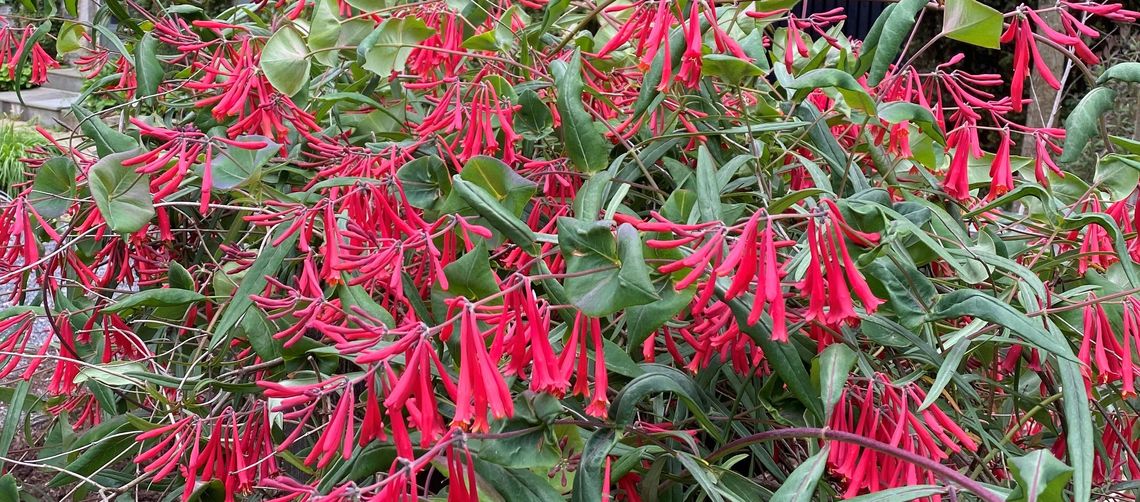
lonicera sempervirens cedar lane belvidere

By Andrew Bunting, PHS Vice President of Horticulture


In the spring in the Delaware Valley there are many birds that migrate to and through our region. There are dozens of species of warblers that come north from Central and South America to either stop in our area on their trip to more northern states or Canada for breeding. Another often anticipated arrival is the Ruby-throated Hummingbird, which is the only species of hummingbird that comes to the Mid-Atlantic. They spend their winters in southern Mexico, Central America as far south as Panama and there are some populations in southern Florida. Their breeding grounds are in most of the eastern half of the United States and southern Canada. In large shrubs or small trees, they construct their two-inch diameter nests about 10-20 feet above the ground out of plant fibers, the fluffy inflorescences of dandelions and spider webs and they are often camouflaged with lichens.

To attract hummingbirds to your home garden some of the earlier flowering vines are an essential nectar source for the arriving Ruby-throated Hummingbirds in the spring. In general, the Ruby-throated Hummingbird is attracted to brightly colored flowers with tubular flowers. There are many selections of the native coral honeysuckle, Lonicera sempervirens (pictured above). This twining vine grows best on a fence or a trellis and will flower best in full sun. ‘Major Wheeler’ is a PHS Gold Medal recipient with coral red flowers in late April to early May. ‘John Clayton’ has sulphur-yellow flowers and ‘Cedar Lane’ has more narrow leaves and carmine-colored flowers. 

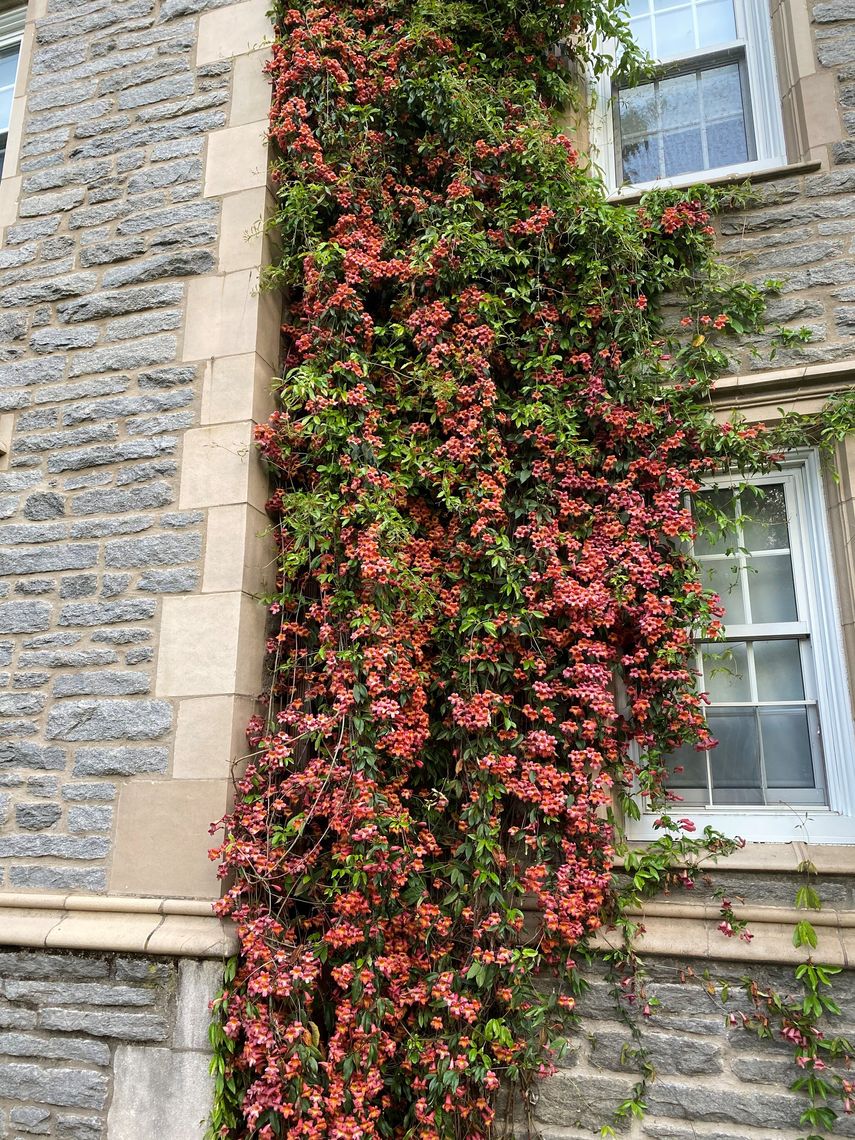
bignonia capreolata tangerine beauty scott arboretum
Bignonia capreolata 'Tangerine Beauty' at Scott Arboretum

Also, blooming in late April to early May is the crossvine, Bignonia capreolata.  ‘Tangerine Beauty’ is also a Gold Medal recipient with reddish-orange flowers. The crossvine occurs naturally in the southeastern states and west to Texas but is perfectly hardy in the Mid-Atlantic. It is a self-clinging vine that can attach to buildings, fences and tree trunks. It has narrow, semi-evergreen leaves that can turn an attractive purple in the fall. The tubular flowers occur before the leaves come out. Flowering can be so dense that an entire call can be covered in a floral display.

Finally, there is also a native wisteria that can be considered for attracting hummingbirds. Wisteria frutescens ‘Amethyst Falls’ has pendant trusses of fragrant, lilac-purple flowers that appear in May and cover the vine. Like the Lonicera, it is a twining vine and will also thrive in full sun.